

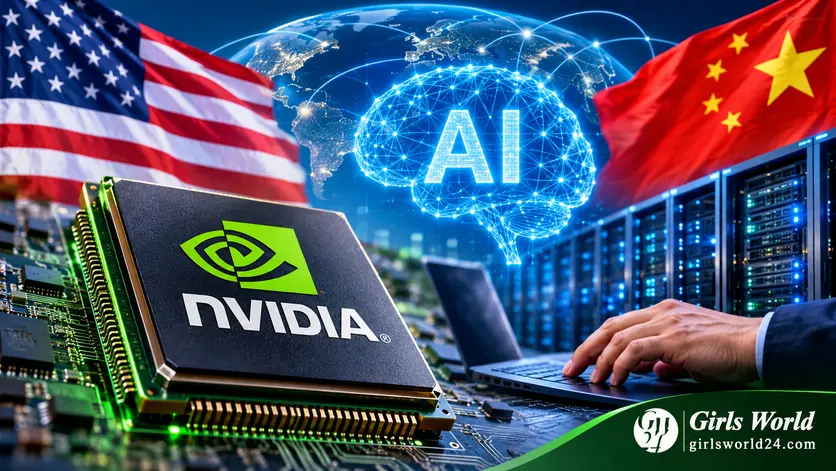
Nvidia and the Global AI Race: Why the US-China Chip Battle Matters

Nvidia and the Global AI Race: Why the US-China Chip Battle Matters
Artificial intelligence is becoming one of the most important areas of global competition, and Nvidia is at the center of the battle. New US restrictions on advanced AI chips are changing how technology companies access computing power, raising questions about the future of the industry.
The global race to develop more powerful artificial intelligence systems is entering a new phase. Technology companies are investing billions of dollars in AI infrastructure, while governments are increasingly treating advanced computer chips as strategic assets.
At the center of this competition is Nvidia, one of the world’s most influential designers of AI processors.
Recent developments in US technology policy and Nvidia’s chip business have highlighted how closely artificial intelligence is now connected to international trade, national security and economic competition.
Why Nvidia Matters in the Global AI Race
Nvidia has become a major player in the artificial intelligence industry because its graphics processing units (GPUs) are widely used to train and operate advanced AI systems.
Unlike traditional computer processors, GPUs can handle large numbers of calculations simultaneously. This makes them especially useful for training complex AI models, processing large datasets and running advanced machine-learning applications.
Major technology companies rely on powerful computing infrastructure to develop AI assistants, image-generation systems, autonomous technologies and other digital services.
As demand for AI computing continues to grow, Nvidia’s chips have become an important part of the global technology supply chain.
- Nvidia and the Global AI Race: Why the US-China Chip Battle Matters
- Pennsylvania Measles Outbreak: 9th Death Confirmed
- Colts vs Texans: Score, Highlights & Stats (Week 11)
- Kivabe Onner Phone Control Korbo
- ইমাম মাহদীর আগমনের ইঙ্গিত 2026 | ইসলাম কী বলে?
US Introduces New Restrictions on Advanced AI Chips
The United States is taking additional steps to control how advanced computing technology is accessed by companies in countries considered national security concerns.
On November 19, 2026, a new US Commerce Department rule established additional licensing requirements for certain advanced semiconductors supplied to overseas data centers that provide significant computing capacity to companies headquartered in China, Macau and other designated destinations.
The rule also introduced additional licensing requirements for certain advanced semiconductor exports to Indonesia, Malaysia, Singapore, Thailand and Brazil.
The measures are designed to reduce the risk of advanced US technology being used in ways that Washington considers a threat to national security.
The new rules demonstrate that the competition over AI is no longer limited to the physical shipment of computer chips. Access to computing power through overseas data centers and cloud infrastructure is also becoming an important policy issue.
Nvidia’s China Business Faces More Pressure
China is one of the world’s largest technology markets, making access to advanced AI processors an important issue for both Chinese companies and international chipmakers.
However, US export restrictions and China’s own efforts to strengthen its domestic semiconductor industry have created additional challenges.
In another significant development, Nvidia said it had stopped shipping certain US-licensed Hopper data-center chips to China, according to a Reuters report published on November 18.
The decision adds further uncertainty to the relationship between Nvidia and China’s technology sector.
Chinese companies, including major technology and cloud service providers, need substantial computing resources to develop and operate advanced AI models.
Restrictions on access to high-performance processors could affect their expansion plans, although the long-term impact will depend on the availability of alternative hardware and domestic technology.
China Is Working to Build Its Own AI Chip Industry
China has been investing heavily in domestic semiconductor production as it seeks to reduce its dependence on foreign technology.
Developing competitive AI processors is a major challenge because advanced chips require sophisticated engineering, specialized manufacturing equipment and highly developed supply chains.
Chinese technology companies are exploring domestic alternatives, while the government continues to support efforts to strengthen the country’s semiconductor industry.
The restrictions could increase pressure on Chinese companies to develop their own hardware and computing infrastructure.
However, building a complete alternative to the global advanced semiconductor supply chain will take time and significant investment.
How the AI Race Could Affect the Global Economy
The competition between the United States and China could have consequences far beyond the technology sector.
Artificial intelligence is already influencing several major industries, including:
Healthcare: AI tools can help researchers analyze medical information, support diagnostic processes and accelerate drug discovery.
Finance: Financial institutions are using AI for fraud detection, risk analysis and customer services.
Education: AI-powered platforms are changing how students learn, research and access educational resources.
Manufacturing: Businesses are exploring automation, predictive maintenance and AI-powered quality control.
Transportation: AI is supporting the development of autonomous systems, traffic management and logistics technologies.
Countries with access to advanced computing infrastructure may gain important economic advantages. At the same time, restrictions on technology exports could influence investment decisions and international business relationships.
What the Global AI Race Means for the United States, UK, Canada and Australia
Although much of the competition is taking place between the United States and China, other developed economies also have a significant interest in the future of artificial intelligence.
The United Kingdom is investing in AI research, infrastructure and technology development. Canada has an established AI research community, while Australia is examining how to balance technological innovation with safety and responsible use.
These countries could benefit from advances in AI through improved productivity, new businesses and technology-related employment.
However, they may also face challenges involving data privacy, cybersecurity, intellectual property and dependence on foreign technology suppliers.
For businesses and workers across these countries, understanding artificial intelligence is becoming increasingly important.
Will Nvidia Continue to Lead the AI Industry?
Nvidia’s position in the AI hardware market gives it significant influence over the development of advanced computing systems.
However, the global semiconductor industry is highly competitive. Other chipmakers are developing alternative processors, while major technology companies are designing their own AI chips to reduce dependence on external suppliers.
The future of the industry will depend on several factors, including computing performance, manufacturing capacity, energy costs, software development and international trade policies.
Nvidia may remain a major force in the market, but the growing competition could gradually reshape the industry’s balance of power.
The Future of Artificial Intelligence
The global AI race is about much more than developing smarter software. It also involves access to computer chips, data centers, electricity, research talent and international supply chains.
The latest US restrictions on advanced computing technology show how governments are becoming more involved in shaping the future of artificial intelligence.
For technology companies, investors and ordinary consumers, these developments could influence how quickly new AI products become available and how the global digital economy evolves.
One thing is clear: artificial intelligence is becoming a major force in the modern world, and the competition to control its underlying technology is far from over.
Sources and Further Reading